“Do I make you nervous Corky?” – Violet
This year has seen an influx of cinemas and festivals revisiting the hottest 1990’s ride-or-die classic of queer cinema – Bound (1996). This queer classic wasn’t always recognised as such despite its breathtaking and sultry sexuality.
Setting the scene
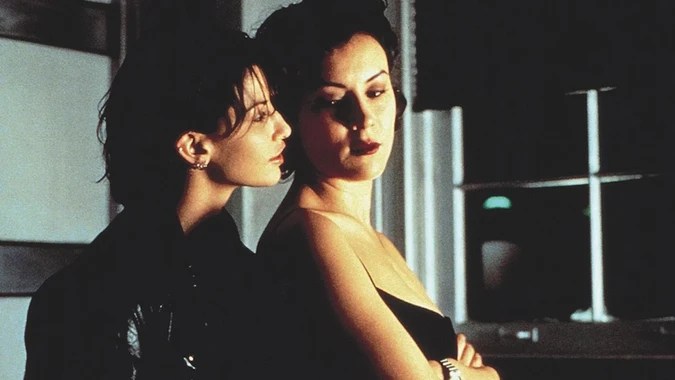
Directed by revolutionary trans sisters Lana and Lilly Wachowski. Bound stars Gina Gershon (Showgirls) as Corky, and Jennifer Tilly (Bride of Chucky) as her lover, Violet.
An unexpected rendezvous in an elevator ignites a sizzling affair between the two women, who soon plot to steal $2 million in laundered mob money and intend to pin the blame on Violet’s incompetent and explosive boyfriend, Caesar played by Joe Pantoliano.
Bound, is one of the first queer films to feature two lesbian characters who are undeniably free-thinking and happily embrace their sexuality. Beginning with seductive glances in the elevator, Violet and Corky can’t take their eyes off each other, Violet waltzes around Corky getting closer and closer until they can no longer deny their unbearable lust. Unapologetically intimate, it sets a precedent of self-acceptance and gives us an ending to live for.
Turning the industry on its head
The first half an hour of Bound sets the scene to justify their crime sharing empathy for the lovers past and present. Bound inverts harmful representations of queerness and femininity from the past of the villainous queer with a bite.
Violet inverts the genre conventions of neo-noir cinema with her loyalty to Corky and she is celebrated for daring to manipulate her image as a femme fatale in a world which is explicitly shown as male-centric.
Typical neo-noir conventions cast the femme fatale as evil, wicked and untrustworthy however Bound gives empathy to Violet as an unsatisfied housewife to the ego-inflated Caesar, who wields her around as a grand prize. We can feel her suffocation through the screen and it leaves us gasping for the fresh air of Corky.
Bound shows Violet as dedicated and devoted to her love for Corky, we may be used to sitting on the edge waiting for the moment she will twist the narrative and run with the money as a femme fatale, but Violet supports Corky until the end, turning old conventions on their head.
New Queer Cinema and Bound’s Recognition
Lana and Lilly Wachowski made their impact as queer filmmakers straight away with their first film, Bound, sharing their story through a realistic queer lens.
Bound has been credited in articles from 2022 (potentially before this too) as being part of the New Queer Cinema from the 1990s.The New Queer Cinema movement was an artistic response to what many lesbian, gay, bisexual, and transgender people saw as a lack of media representation of their own lives and experiences. We may not all be involved with the Mafia but Bound shares the reality of their forbidden love.
However, during the 1990s critics failed to recognise Bound as part of the movement. Lana Wachowski famously raised the issue in 2014, while accepting the 2014 Equality Illinois Freedom Award, asking “How come no one ever mentions Bound? I’m curious about that”.
This lack of recognition was in part due to the film industry financing which formerly disqualified it from consideration under B. Ruby Rich’s 1992 definition of the New Queer Cinema Wave as an independently funded movement.
Lana and Lilly Wachowski had also not transitioned before the film’s release and as a result were not recognised as queer or transgender filmmakers, credited on Bound as the Wachowski Brothers.
This lack of recognition calls for critics and the press to consider the history of LGBTQ+ representation, lived experiences and difficulties coming out especially under the public eye when considering what they label as queer cinema.
A queer icon from the start
“Are you thirsty” – Violet
Bound is full of subtle coding which to the heteronormative eye could easily be missed until it’s really not. The Labrys (double-headed axe) tattoo on Corky’s arm has been a symbol for lesbianism since the 1970s (today, the usage of the labrys has waned in the queer community due to its association with second-wave lesbian feminism and TERFs).
Part of the credit for the lesbian queer coding throughout the film is down to Susie Bright, feminist writer and sex educator who choreographed the intimate scenes on set. The Wachowskis were long fans of Bright and sent her a copy of the script with a letter asking her to be an extra in the film. Bright understandably loved the script, particularly as it was about women unapologetically having and enjoying sex, Bright offered to be an intimacy coordinator for the film.
Throughout Bound we can see touches from Susie that nod to the lesbian community, including the focus on hands and the undeniable wetness that slithers from beginning to end – from the gushing sink, Violet’s painted lips, Corky’s dewy leather jacket and the splattering of blood and paint everything in this film glistens. And how could we forget about closets – watch out for the fragile Caesar trying to take back his power.
It is time Bound steps out of the closet into the spotlight, recognized as the ground-breaking work of LGBTQ+ cinema that it is.
References;
Cael, M Keegan; Lana and Lilly Wachowski (2018) University of Illinois Press; pages 8-12

 MusingsofHope